
The route, section by section
| Section | Distance | Nature |
|---|---|---|
| Dakar → Kaolack | about 190 km | Continuous motorway since August 2026 |
| Kaolack → Tambacounda | — | RN1, tarmacked |
| Dakar → Tambacounda | 460 to 500 km | Sources diverge |
| Tambacounda → Kédougou | 232 to 235 km | RN7, under construction (see below) |
| Dakar → Kédougou, total | ~700 km | 8 to 12 hours |
A point of vocabulary that avoids a lot of confusion: the Dakar – Kaolack – Tambacounda segment is the national road 1. The "RN7" that the Senegalese press talks about is the Tambacounda – Dialacoto – Mako – Kédougou axis and beyond towards Mali. When an article announces works on the RN7, it is not talking about the Dakar half of your journey.
The question that decides everything: one day or two?
Eight to twelve hours on the road, the range is wide and it is honest: three independent sources give it, and the gap comes from the state of the road surface on the second half.
Technically, doing it in a day is possible. But it assumes a departure before dawn and it tolerates no mishap, whereas driving at night between towns is not advised by official guidance — no street lighting, pedestrians on the roads, high accident rates. So you have no margin to make up time in the evening: if you fall behind, you do not catch up, you stop.
The overnight stop at Tambacounda is the pattern the sources recommend, and it is the only stopover town cited: fuel, repairs, accommodation, at the halfway point. No source suggests an intermediate stop between Dakar and Tambacounda — Kaolack is too close to be useful.
Our position: if you are travelling as two and take turns driving, the day is feasible by leaving at five o’clock. If you are driving alone, break the trip at Tambacounda. The journey is not a feat of endurance, and you will need to be fresh for what comes afterwards.
The state of the RN7: what we know, up to a point
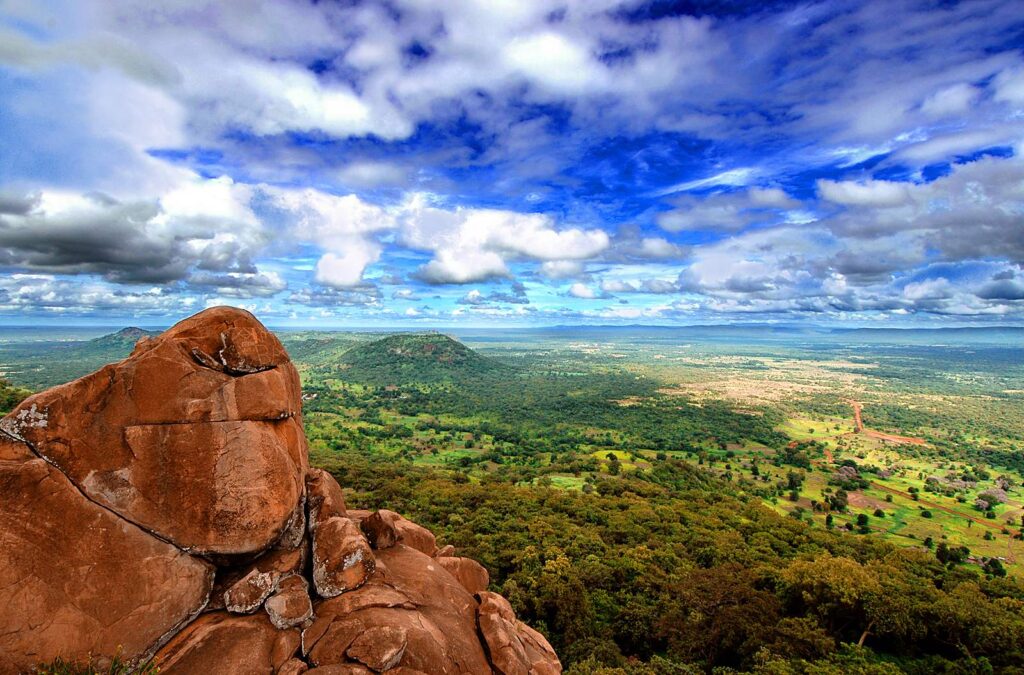
A major works programme is under way on the RN7: around 136 kilometres spread over the Mako – Kédougou, Kédougou – Saraya and Saraya – Moussala sections, for some fifty billion F CFA. In January 2026, the completion rates announced by the minister during a site visit were 85% on Mako – Kédougou and 79% on Kédougou – Saraya. In February 2026, AGEROUTE Tambacounda declared Mako – Kédougou "almost finished" and announced the end of the works before the rainy season.
So much for the official statements. Now for the honesty: no source consulted confirms the actual completion of these works after February 2026, and above all, no source describes the real state of the road surface between Tambacounda, Dialacoto and Mako in 2025 or 2026. The last detailed accounts of this section date from 2017-2019, when it was described as hell for lorry drivers. Those descriptions are too old to be relied upon, and nothing recent replaces them.
Practical conclusion: we give you eight to twelve hours because that is the range the recent sources give, and we invite you to enquire locally before setting off rather than take our word for it on this particular section.
The park you are going to cross
A detail that many people discover en route: the RN7 crosses the Niokolo-Koba national park, between Dialacoto and Mako. You do not enter it deliberately, the road runs through it.
The park’s internal regulations, a 1976 order that remains the only text we have been able to consult, prohibit traffic inside the park from sunset to sunrise except on the national road. Night-time transit is therefore not prohibited by this text — contrary to what certain websites claim. That does not make it advisable for all that: wildlife on the road, no lighting, Malian heavy goods traffic. A fatal accident did in fact occur on this section in May 2026.
If you want to visit the park rather than cross it, that is another matter. The main entrance is at Dar Salam. The fees, consistent across three sources, are 5,000 F CFA per person per day for a foreigner — 3,000 F CFA for a national —, 10,000 F CFA for the vehicle and 10,000 F CFA per day for the official guide, who is compulsory. The same 1976 order limits the visit to 30 km/h, allows it only by vehicle and prohibits getting out except at the designated stops.
One point we do not know: no source says whether a simple transit on the RN7, without stopping, gives rise to an entry fee being charged. Do not set off assuming that it does, nor that it does not — plan to have the means to pay.
Good news along the way: Niokolo-Koba was removed from the List of World Heritage in Danger in July 2024, while remaining inscribed as World Heritage since 1981.
Bassari Country: what it is exactly
Bassari Country has been inscribed on the UNESCO World Heritage list since 2012, under the official name "Bassari Country: Bassari, Fula and Bédik cultural landscapes". We specify the date because one official Senegalese source states 2013 — that is an error, the World Heritage Committee’s decision dates from its session in June 2012 in Saint Petersburg.
It is not a single place, it is a set of three distinct geo-cultural zones:
Bassari – Salémata, about 78 kilometres from Kédougou. And here is the change that most guides have not taken on board: this road has been tarmacked. The 77.6 kilometres of the Kédougou – Salémata road were inaugurated on 14 November 2023. The Bassari zone is therefore accessible on a surfaced road, which overturns all the earlier literature.
Bédik – Bandafassi. The perched villages — Iwol above Ibel, Andjel, Ethiolo — are reached on foot after the point where you leave the vehicle. On the length of the climb, the sources frankly contradict one another, from fifteen minutes to an hour and a half depending on the village, and we will not settle it. Nor on the Kédougou – Bandafassi distance: two French-language sources give fifteen kilometres but may be copying each other, and other figures are incompatible. We will not publish a distance.
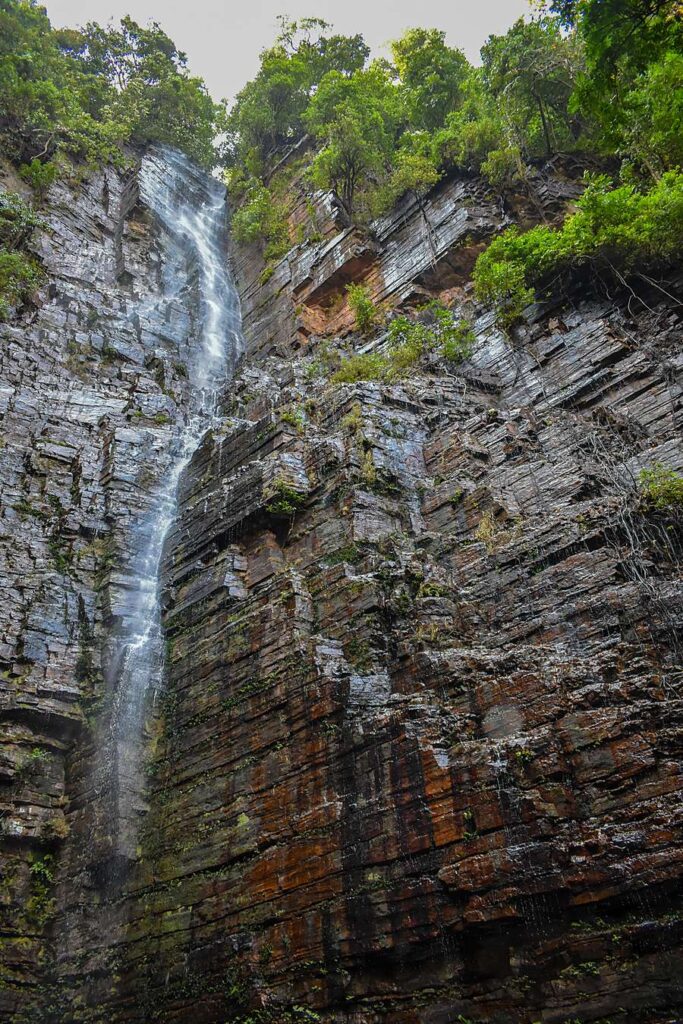
Fula – Dindéfélo, about 36 kilometres from Kédougou, less than an hour. That is where the waterfall is — a hundred metres or so, perhaps 115 according to the sources — and the community nature reserve, a sanctuary for West African chimpanzees.
On access to Dindéfélo, a point that matters for your choice of vehicle: the track is described as passable by bush taxi, and a travel account from February 2025 reports the journey by shared taxi. The only opinion asserting that a 4x4 is indispensable there comes from an operator who rents out vehicles with a driver. In the dry season, a vehicle with raised ground clearance is enough for Dindéfélo.
The reserve’s fees, recorded in April 2026: 1,000 F CFA for a national, 2,000 F CFA for a foreigner; chimpanzee observation at 30,000 F CFA per person; an accredited local guide is compulsory.
⚠ An alert we must flag
In early March 2026, violent bush fires struck the Dindéfélo community nature reserve: some fifty hectares destroyed, tourist areas included, six villages threatened. A major travel guide was, at that date, maintaining an alert indicating that access to the waterfall and the trails could be dangerous, even impossible.
Checked on 25 September 2026: the alert is still online, in the same terms as in March, and no source lifts it. What we do know is that the reserve has organised itself: in April 2026 the Senegalese press agency described the recruitment of twenty-four ecoguards, the cutting of firebreaks and controlled early burning to reduce the fuel load. That does not amount to a reopening.
Contact the reserve’s welcome centre before planning Dindéfélo into your itinerary, and keep a fallback for the day. We cannot tell you that all is well, and we are not going to pretend otherwise.

The season: the one real trade-off of the trip
The rainy season at Kédougou runs approximately from June to October, with a very wet month of August. The official French guidance is explicit: do not use the tracks during the rainy season.
The visiting window is therefore November to May. But within that window, there is a trade-off to make, and it is a cruel one: the waterfalls are at their maximum flow at the end of the rainy season, between August and November, that is precisely when the tracks are at their worst.
The best documented compromise is November-December: the tracks have dried out, the waterfalls are still fed. December to February offers the most comfortable temperatures, around 30-33°C by day and 16-18°C at night. April and May are the hottest months, with maxima approaching 40°C — we do not recommend it for a trip that involves walking uphill.
As a couple: why this trip will suit you
We have written elsewhere on this blog that a couple heads to Saint-Louis in a saloon. The same couple, here, takes a 4x4. This is not a contradiction, it is the principle: it is the destination that chooses the vehicle, not the number of passengers.
As two, this trip has a quality the others do not. You have no group-timetable constraint, you can decide on the morning itself to stay one more night in a village, you take turns at the wheel on the long sections, and you need neither a large boot nor a pick-up bed. What you need is ground clearance, four-wheel drive for the tracks, and a vehicle you can rely on seven hundred kilometres from Dakar.
Two safety rules, as two, far from everything:
Water and a full tank. No source documents where the petrol stations are located between Tambacounda and Kédougou. None says whether there are any at Dialacoto or at Mako. It is a genuine information gap, and the only reasonable course is a full tank at Tambacounda, with plenty of water. For your budget: super is 990 F CFA per litre and diesel 755 F CFA since 15 August 2026, and reckon on 6,500 F CFA of toll for the motorway section from Dakar to Kaolack.
The network. A single source describes coverage as "sporadic beyond the major towns". One source is not a map. Download your offline maps, and tell someone where you are going.
Resident or visitor
If you live in Senegal
Kédougou is the trip you keep putting off and which is worth the journey. Reckon on a week, not a long weekend: two days on the road there and back, and the rest on site. National rates apply everywhere — 3,000 F CFA instead of 5,000 F CFA at Niokolo-Koba, 1,000 F CFA instead of 2,000 F CFA at Dindéfélo — and, with those rental companies that offer one, the resident rate applies to your rental.
If you are coming from abroad
be clear-eyed about the time budget. Seven hundred kilometres out, as many back: over a ten-day trip, that is two full days on the road. Bassari Country is worth that price, but it is worth it only if you stay long enough on site for the journey to make sense. Three nights minimum at Kédougou, otherwise give it up and keep it for another trip.
So then, which car?
A 4x4. But for the right reasons, and here is the dividing line as the sources draw it.
The 4x4 is not necessary on Dakar – Kaolack – Tambacounda, which is a tarmacked road. Nor is it necessary on Kédougou – Salémata, surfaced since 2023, nor on Kédougou – Dindéfélo in the dry season, where the track is passable in an ordinary vehicle.
The 4x4 is indispensable for entering Niokolo-Koba away from the national road: three sources assert this without qualification, a taxi will not get you far. It is indispensable for the secondary waterfalls of Bassari Country reached by long tracks — a single, commercial source says so, and we report it with that reservation. And it is indispensable on any track during the rainy season.
In other words: you are not renting a 4x4 to do the seven hundred kilometres. You are renting it for the last fifty, which are the ones you came for. It is a nuance, but it saves you from paying for an off-roader for a stay that would be limited to Kédougou and Salémata — in which case a SUV with raised ground clearance would suffice.
One last thing, and it holds for this trip more than for any other: check the state of the vehicle before setting off. Tyres, brakes, spare wheel, basic tool kit. Seven hundred kilometres from Dakar, on a road whose exact condition on one section we have just told you is unknown to us, this is not a formality.
Frequently asked questions
Do you really need a 4x4 to get to Kédougou?
Not to get there: no source presents the 4x4 as necessary to reach Kédougou, as the road is tarmacked. It becomes indispensable for entering Niokolo-Koba park away from the national road, for the secondary tracks of Bassari Country, and on any track during the rainy season. If your stay is limited to Kédougou, Salémata and Dindéfélo in the dry season, a SUV with raised ground clearance is enough.
How long does the Dakar – Kédougou journey take?
From eight to twelve hours for about 700 kilometres, depending on the state of the road surface. The journey can be done in a day with a departure before dawn and two drivers, but the overnight stop at Tambacounda, at the halfway point, is the pattern the sources recommend — all the more so as driving at night between towns is not advised and leaves no margin to make up time.
What is the best time to go?
November to May, the rainy season running from June to October and making the tracks inadvisable. The best compromise is November-December: the tracks have dried out and the waterfalls are still fed. December to February offers the most pleasant temperatures. Avoid April and May, the hottest, with maxima close to 40°C.
Does the road cross Niokolo-Koba park, and do you have to pay?
Yes, the RN7 crosses the park between Dialacoto and Mako. The park regulations explicitly allow night-time traffic on the national road, but we advise against it: wildlife on the road and heavy goods traffic. No source says whether a simple transit without stopping gives rise to an entry fee being charged — plan to have the means to pay. To visit the park, reckon on 5,000 F CFA per person per day for a foreigner, 3,000 F CFA for a national, 10,000 F CFA for the vehicle and 10,000 F CFA for the compulsory guide.
Is Bassari Country accessible by car?
In part. The Bassari – Salémata zone has been served by a tarmacked road since November 2023. Dindéfélo is reached by a track passable outside the rainy season. But the perched Bédik villages, Iwol and the others, are reached on foot from a drop-off point: the car does not go up.
Can you get there by plane?
There is an airport at Kédougou, but no source consulted confirms the existence of a regular commercial service from Dakar in 2026. Do not build your trip on that assumption without having verified it directly with the airlines.