
The figure to watch is not the distance
Reckon on between 255 and 270 kilometres. We give a range rather than an exact figure because the sources do not agree: route calculators quote anywhere from 224 to 290 km depending on the starting point chosen within Dakar. That does not matter much, because the distance is not what shapes your day.
What shapes it is the duration: three and a half to four and a half hours. Over 260 kilometres. Do the division: you will be driving at an average of between 58 and 74 km/h on a road that nothing degrades. The explanation comes down to three words — Dakar, villages, checkpoints.
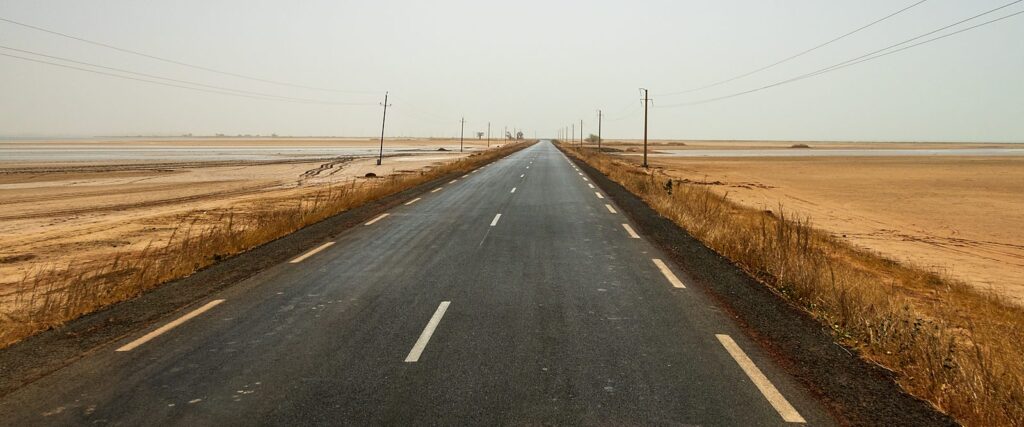
Getting out of Dakar costs you dear. After that, the N2 does not bypass the towns, it goes through them: Thiès, Tivaouane, Ngaye Mékhé, Kébémer, Guéoul, Louga. Each crossing comes with very pronounced speed bumps, often unsigned — a point noted by both driving guides and French travel advice. Add the police and gendarmerie checkpoints, frequent on the main roads, and the carts, pedestrians and two-wheelers sharing the carriageway.
The one tip that changes everything: leave early. Not "in good time" — early. Getting out of Dakar before 7 am gains you more than any decision taken afterwards.
What you will pay
| Item | Amount | Detail |
|---|---|---|
| Toll Dakar → AIBD (A1) | 2,000 F CFA | Light vehicle, total across the three toll stations on the route |
| Toll AIBD → Thiès (A2) | ~1,000 F CFA | Ballpark figure: only two sources, to be checked at the booth |
| Beyond Thiès | 0 F CFA | The N2 has no toll all the way to Saint-Louis |
| Super petrol | 990 F CFA per litre | Rate in force since 15 August 2026 |
| Diesel | 755 F CFA per litre | Same |
Two honest remarks about this table. First: we do not give you a total fuel budget, because it depends entirely on the vehicle and any single figure would be made up. Take the consumption stated by the owner, multiply by 5.4 for the round trip, then multiply by the price per litre. Second: the AIBD–Thiès toll is the only amount on this page that we could not cross-check three times. The official schedules are published as unreadable images. Treat it as a ballpark figure.
The motorway that does not exist yet
You will read, more or less everywhere, that a motorway links Dakar to Saint-Louis. That is false, and it is important to know before working out your timing.
The project does indeed exist: 200 kilometres, a route that starts from the extension of the VDN near Lac Rose and runs through Kayar, Notto and Tivaouane before following the N2. But no section was open to traffic in 2026. The works were put at around 40% complete in spring 2026, with completion announced for January 2027 — a schedule we invite you to treat with caution: on the Saint-Louis side, the residents concerned were still reporting in January 2026 that earthworks had not begun near them.
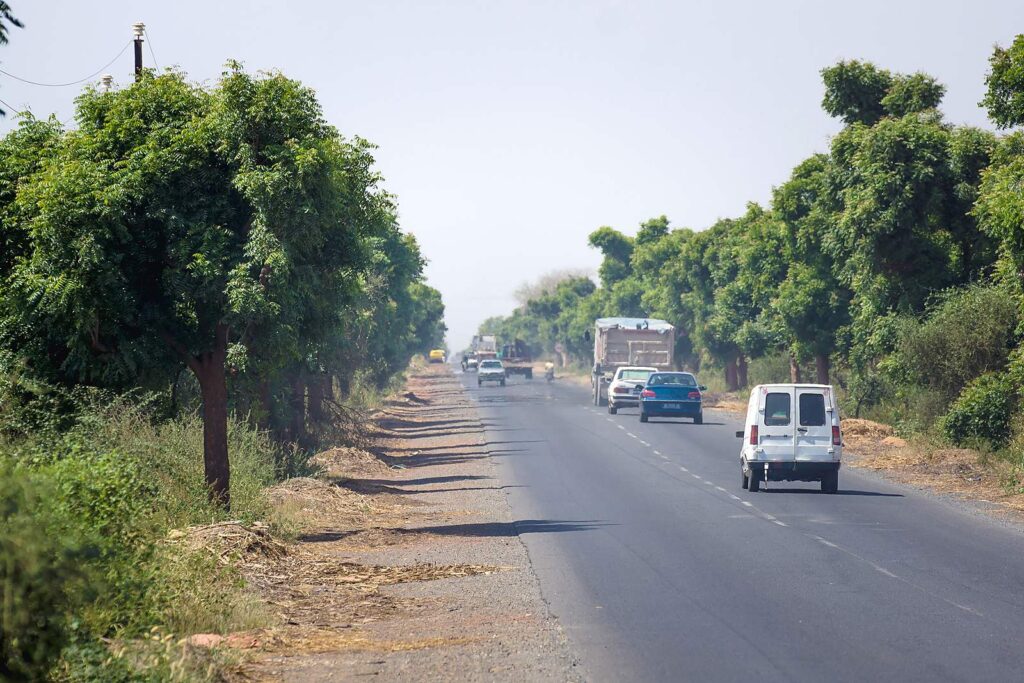
In practical terms: until further notice, you drive on motorway as far as Thiès, then on a two-way national road. Plan your timing accordingly, and be wary of journey times found on sites that assume the road is open.
The date that can cost you half a day
Here is the detail that no one tells you and that the regulars know by heart: the N2 goes through Tivaouane, holy city of the Tijaniyya brotherhood, and every year Tivaouane hosts the Gamou, one of the largest religious gatherings in the country.
In 2026, the Gamou fell on Tuesday 25 August, with a prefectoral traffic plan in force from 22 to 26 August: one-way streets, pedestrian zones around the mosques and mausoleums, northern and southern bypasses, four drop-off areas at the entrances to the town. More than 2,500 gendarmes deployed, 420 buses and 42 trains chartered for the pilgrims.
The date follows the lunar calendar and so shifts by about ten days each year. Before setting your weekend, check the date of the Gamou. It is not a reason to stay away — it is a considerable moment to experience if that is what you are looking for — but it is a very unpleasant surprise if you thought you were just passing through.
Where to stop, and where to stop stopping
A Dakar–Saint-Louis round trip over the weekend is eight hours on the road. They may as well be put to good use.
Thiès, at 70 kilometres. The country’s second city, and the one stop that is worth it even when you are in a hurry. The Manufacture sénégalaise des arts décoratifs weaves tapestries there using the Aubusson technique; the historical museum occupies the former Fort Faidherbe of 1864; the colonial quarter and the central market near the station can be seen in an hour. It is also the right place for a proper breakfast if you set off at 6 am.
Ngaye Mékhé. Senegal’s leather capital, with its "Dallu Ngaay" brand. You can haggle for shoes at between 5,000 and 10,000 F CFA. The weekly market is held on Mondays — if you head back on a Sunday evening, you miss it by a day.
The Lompoul desert: read this before you go. It is the classic detour on this route, and we cannot recommend it as we once did. The site is today deeply affected by the zircon mining carried out on the Grande Côte, in a concession that covers around a hundred kilometres of coastline and whose operations are planned at least until 2029. The historic camps have disappeared or been relocated, and a reconstructed site has been created by the mining operator — a move that several sources bluntly call greenwashing. Find out about the real state of the site at the time of your trip rather than relying on photos from five years ago. And if you do go: the last seven kilometres are on a sandy track, by 4x4 or by the camp’s shuttle. It is not a detour for your saloon.
Resident or visitor: it is not the same trip
If you live in Dakar
Saint-Louis is your two-day weekend par excellence: you leave on Saturday at dawn, sleep there, and return on Sunday in the late afternoon. The calculation that matters for you is not the price of the rental but the fact that you do not depend on the timetable of public transport — you leave when you want and stop where you want. With the hire companies that offer one, the resident rate appears on its own once your resident account is verified.
If you are passing through Senegal
the temptation is to do Saint-Louis in a day from Dakar. Do not do it. Eight hours on the road for three hours on site, with a night return that absolutely must be avoided, is the best way to end up hating a magnificent city. Sleep in Saint-Louis. One night minimum, two if you want to push on to the Djoudj park, some sixty kilometres to the north, open from November to June.

When to go
The good window is November to March: dry road, bearable temperatures, and it is also the best time for the Djoudj if you extend your trip.
The rainy season runs from July to October. Contrary to what you sometimes read, we found no source documenting a closure of the N2 during the rainy season — the road being tarmacked along its whole length, it does not get cut off. What the rainy season degrades is the detour tracks: Lompoul, Gandiol, the surroundings of the Djoudj. The risk, in the rainy season, is the side programme, not the journey itself.
So, which car?
A passenger car. Saloon, compact, city car — the journey asks for nothing more, and the sources that describe this road explicitly recommend this type of vehicle.
Three points to watch all the same, which have nothing to do with off-roading:
Air conditioning. It is the one non-negotiable piece of equipment. Four hours on the road in the Sahel without air conditioning is not a saving, it is a mistake.
Minimum ground clearance. Not for the track — for the speed bumps. They are high, numerous and often invisible. A very low-slung car will suffer, not from any difficulty getting through, but from scraping at every village.
The spare wheel and its condition. Check it before you leave, not on the side of the N2. Along with the warning triangle, the hi-vis vest, the vehicle’s papers and your licence, it is the departure checklist.
Frequently asked questions
How long does it really take to go from Dakar to Saint-Louis by car?
Between three and a half and four and a half hours for 255 to 270 kilometres. The variation does not come from the state of the road, which is good, but from the hour you leave Dakar, the village crossings with their speed bumps, and the road checkpoints. Leaving before 7 am is the only real lever.
Do you need a 4x4 to go to Saint-Louis?
No. The road is tarmacked from end to end and a passenger car is more than enough. The 4x4 only becomes useful for detours off the N2: the seven kilometres of sandy track of the Lompoul desert, and possibly the last kilometres towards the Djoudj park — on which the sources contradict each other, some saying a 4x4 is needed, others a normal vehicle.
Is the Dakar–Saint-Louis motorway open?
No. No section was in service in 2026. The toll motorway stops at Thiès; beyond that, it is the national road 2. The 200 km project exists, it was put at around 40% complete in spring 2026 with delivery announced for January 2027, but that schedule is to be treated with caution.
How much is the toll on this route?
2,000 F CFA for a light vehicle from Dakar to the AIBD, plus around 1,000 F CFA from the AIBD to Thiès — this second amount being one to check at the booth, as we were not able to cross-check it sufficiently. Beyond Thiès, the N2 is free.
Can you do the round trip in a day?
Technically yes, but we strongly advise against it. It means eight hours of driving and a return at the end of the day, whereas night driving between towns is advised against by all official advisories — no lighting, pedestrians and animals on the carriageway, vehicles without lights. Sleep there.
What does the rainy season change on this road?
Little on the N2 itself, which is tarmacked and for which we found no source reporting a closure. It is the detour tracks — Lompoul, Gandiol, Djoudj — that become difficult from July to October. The best time remains November to March.