
The trip in one picture
| Section | Distance | Duration | Condition in 2026 |
|---|---|---|---|
| Dakar → Kaolack | 184 to 190 km | ~2 h | Continuous motorway since August 2026 |
| Kaolack → Senegambia Bridge | — | ~3 h | Trunk road, plus border formalities |
| Sénoba → Ziguinchor | — | ~3 h | RN4 being rehabilitated, completion announced for late 2026 |
| Ziguinchor → Cap Skirring | ~70 km | far more than an hour | Very degraded — see below |
| Dakar → Ziguinchor, total | 450 to 490 km | 7 to 10 h | Formalities included |
The good news about the first third of the trip is recent: the Mbour – Fatick – Kaolack motorway opened on 22 August 2026, one hundred kilometres of dual carriageway. So you reach Kaolack on continuous motorway, for a 6,500 F CFA toll in a light vehicle.
The Gambia: what we know, and what we refuse to make up
This is the most poorly documented section of the whole trip, and we are going to tell you why rather than pretend otherwise.
No consolidated official Gambian schedule of fees is publishable online. The figures you will find come either from travellers’ accounts or from administrative sheets, and they vary by a factor of one to five depending on the source and the year. So here is what is established, and what is not.
What is solid. The bridge toll for a light vehicle is around 250 dalasi, that is roughly 2,500 F CFA — three independent sources converge to within 20%. French nationals do not need a visa in advance: a short stay of fifteen days is issued free of charge on arrival, including at land borders. The documents to present are the passport, the vehicle registration document, the driving licence and the ECOWAS insurance certificate, the well-known ECOWAS Brown Card, in which Senegal takes part with seventeen member companies.
What is not. The vehicle pass (temporary import permit), issued by Gambian customs: an official French sheet quotes it at around two euros, a traveller’s account details 5,000 F plus 2,000 F of stamp duty on entry and 5,000 F plus 1,000 F on exit, an older source mentions 1,000 F officially and 1,500 to 3,000 F in practice. We will not publish a firm amount. Bring cash, in F CFA and if possible in dalasi, and assume the real range lies somewhere between a few hundred and a few thousand francs.
The price of the Brown Card is not known to us either. It is obtained from an insurer; the Senegalese national bureau is in Dakar.
The opening hours. Two pages of the same website give 7 am – 7 pm. A single source, then. We will not make a rule of it: turn up in the morning, that is the only advice we can honestly give.
The checks. They are numerous on the Gambian side, and several accounts report demands for informal payments. That is not a reason to give up, it is a reason to have your papers in order, your change counted out and a little patience.
A useful piece of context. In August 2024, a dispute over a beacon tax imposed on Senegalese lorries blocked the Trans-Gambia Highway for more than ten days at Keur Ayib and Sénoba. Those taxes targeted freight and not private individuals, so they do not concern you directly — but they are a reminder that this route can occasionally be blocked. Check the day before you leave.

The 70 kilometres nobody talks about
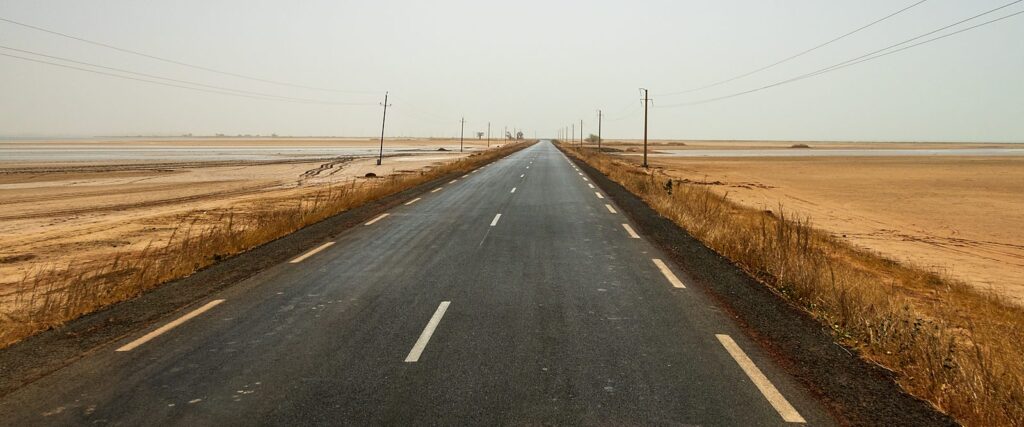
Everywhere you look you will read that Ziguinchor – Cap Skirring is seventy kilometres and an hour on the road. The first figure is right. The second is theoretical, and it has become frankly so.
In December 2025, the President of the Republic publicly referred to "extremely difficult" driving conditions on this route and launched maintenance works with a first phase of ten billion F CFA. In August 2026, after the rainy season, the local press was still describing a succession of potholes turned into deep craters.
This is the central fact of this article and the only truly solid argument in favour of a high-riding vehicle on this trip. Not The Gambia, not the distance, not the Trans-Gambia Highway: the last seventy kilometres.
So do not allow an hour for this section. And above all, do not plan it for the end of the day: arriving at night on a road riddled with craters, after eight hours of driving, is the scenario to avoid.
It should be noted, all the same, for completeness: the RN4 between Sénoba and Ziguinchor is being rehabilitated — 165 kilometres, plus 52 kilometres of the Kalounayes loop — with completion announced for late 2026. That section should therefore improve.
The option few people consider: putting the car on the boat
We are a car hire website, and yet we are going to tell you this: you can do this trip without driving the Trans-Gambia Highway.
The Dakar – Ziguinchor sea link is operated by COSAMA. Three ships serve the line: the Aline Sitoé Diatta, the Diambogne and the Aguène, running four round trips a week in each direction. The crossing takes about fourteen to fifteen hours, including the technical stop at Carabane, with a departure from Dakar in the evening and an arrival the next morning.
And above all: the Aline Sitoé Diatta takes vehicles on board, for around 63,000 F CFA — the two sources that give this rate are almost identical, one specifying that handling accounts for 10,000 F of it. The other two ships are listed without a garage.
Who is this for? A group that wants the car there but not the day on the road, someone who has time on the way out but not on the way back, or someone who does not fancy dealing with a border crossing. You leave in the evening, you sleep on board, you collect the vehicle in Ziguinchor in the morning. There is no official online booking: tickets are bought at the maritime terminals in Dakar or Ziguinchor.
There is also the plane, now. Ziguinchor airport, closed since April 2022, was brought back into service on 30 April 2026, with a first commercial flight on 1st May. Transair serves Ziguinchor daily except Thursday and Cap Skirring several times a week from AIBD, for a forty to fifty minute flight. But you cannot put your car on the plane — and if there are five of you travelling with equipment, the bill changes.
Among friends: what makes the difference
This trip is made for a group, and for a simple reason: it is the only format in which eight to ten hours on the road become a good day rather than an ordeal.
Drive in shifts. On this trip, that is not a convenience, it is a safety measure. Driving is advised against at night between towns by every official notice — no lighting, pedestrians on the carriageways, high accident rates — and you absolutely must arrive before nightfall. Two drivers taking turns make it possible to leave really early without accumulated fatigue.
A single vehicle is better than two. At the border, each vehicle means a vehicle pass, a queue, documents. A double-cab pick-up carries five people and their belongings in one go. That is one border crossing instead of two.
The load bed. This is the concrete argument. Surfboards, diving gear, cool boxes, bags for five: on a degraded road, a boot loaded up to the roof is a genuine handling problem. A covered load bed settles the question.
Fuel. A single source documents the network of petrol stations on this route, and it describes them thinning out beyond Oussouye towards Cap Skirring. One source is not enough to make a rule of it — but enough to apply the principle: fill up completely in Ziguinchor, never go below a quarter of a tank.
What you need to know about the Casamance itself
Let us speak frankly about safety, because it is the question your family will ask you.
The peace process has clearly progressed: an agreement with one faction of the MFDC in March 2023, a laying down of arms in August 2022, several hundred ex-combatants disarmed in late 2023. Negotiations with another faction remained unfinished as of the date of our most recent sources.
The official French advice, updated on 1st July 2026, identifies as passable routes the Diouloulou – Bignona – Ziguinchor road and the Trans-Gambia Highway, recommends not travelling alone, and states that the Cap Skirring hotel zone presents no particular danger.
A residual risk of anti-personnel mines remains in certain forested areas bordering Guinea-Bissau. It concerns forest tracks, not the surfaced roads you will be using. The rule that follows is simple and worth respecting to the letter: do not stray from the roads and tracks in regular use, do not cut through the woods, do not park outside spaces that are obviously in use.
Resident or visitor
If you live in Senegal
the road makes full sense: you have the flexibility of an outward trip on the Trans-Gambia Highway and a return by boat if fatigue sets in, you know the etiquette of the checks, and, with hire companies that offer one, the resident rate appears automatically once your resident account has been verified.
If you are coming for ten days
ask yourself about the real cost. Two full days on the road out of a ten-day stay is a fifth of the trip. The plane on the way out and a car hired on the spot in Ziguinchor may be the best combination — that is not what it is in our interest to sell you, it is what is true.
Taking the car out of the country: the rule, and what remains unknown
On the Senegalese side the rule is written down, and it is ours: our rental conditions prohibit crossing a border without the owner’s written agreement. Where that agreement is given, the owner supplies a valid ECOWAS Brown Card and the territorial validity of the cover has to be checked. So this is not a grey area: it is a named authorisation, to be obtained before booking.
What remains unknown is narrower, and we will not fill it in: the exact documents required on the Gambian side for a hire vehicle, the firm amount of the vehicle pass and the real opening hours of the border posts. Our page on crossing into The Gambia brings together what is established and what is not.
The practical consequence is clear. A trip into The Gambia is not something to improvise: it is decided with the owner before booking, checking that the insurance covers the route and that you have the necessary documents. Ask the question from the very first contact, not the day before departure. And if the answer is no, the boat option remains fully open.
Frequently asked questions
How long does it take to drive from Dakar to Cap Skirring?
Seven to ten hours to reach Ziguinchor, border formalities included, over 450 to 490 kilometres via the Trans-Gambia Highway. Then add the seventy kilometres to Cap Skirring, which today take far more than the theoretical hour given the state of the road surface.
Do you still have to take a ferry to cross The Gambia?
No. The Senegambia Bridge, inaugurated on 21 January 2019 at Farafenni, has replaced the ferry. It is 942 metres long and the toll is around 250 dalasi, that is roughly 2,500 F CFA for a light vehicle. It is this bridge that made the road to the Casamance passable within the day.
What papers do you need to cross The Gambia?
Passport, vehicle registration document, driving licence and ECOWAS insurance certificate — the Brown Card. A vehicle pass is issued by Gambian customs against a receipt; the published amounts vary too much from one source to another for us to quote one. French nationals obtain a fifteen-day short stay free of charge on arrival. Bring cash.
Can you avoid The Gambia?
Yes, in two ways. By road, going round to the east via Tambacounda and Kolda: roughly 860 to 910 kilometres, but the duration estimates range from eleven to twenty-four hours depending on the source and we could not settle it. Or by sea, loading the vehicle onto the Aline Sitoé Diatta for around 63,000 F CFA and a fourteen to fifteen hour crossing.
What vehicle for the Casamance?
A vehicle with raised ground clearance, pick-up or SUV. The justification is not the Trans-Gambia Highway, which is a normal road, but the state of the Ziguinchor – Cap Skirring road, described in August 2026 as riddled with deep craters, and the deterioration of the secondary network in the Casamance after the rainy season.
Is the Casamance safe?
The official French advice of July 2026 states that the Cap Skirring hotel zone presents no particular danger, identifies the Trans-Gambia Highway and the Diouloulou – Bignona – Ziguinchor road as passable, and recommends not travelling alone. A residual mine risk remains in forested areas bordering Guinea-Bissau: do not leave the roads and tracks in regular use.