Two gateways, not one destination
The first thing to understand, because it determines everything else: the delta has two distinct entrances that do not replace one another.
The northern gateway serves Ndangane, Fimela, Simal, Mar Lodj and Palmarin. You reach it via Mbour, then the N1 as far as the Ndiosmone junction, then the Ndiosmone – Diofior – Fimela – Ndangane road.
The southern gateway serves Sokone, Toubacouta and Missirah. You reach it via Kaolack and national road 5, or via Fatick and the Foundiougne bridge.
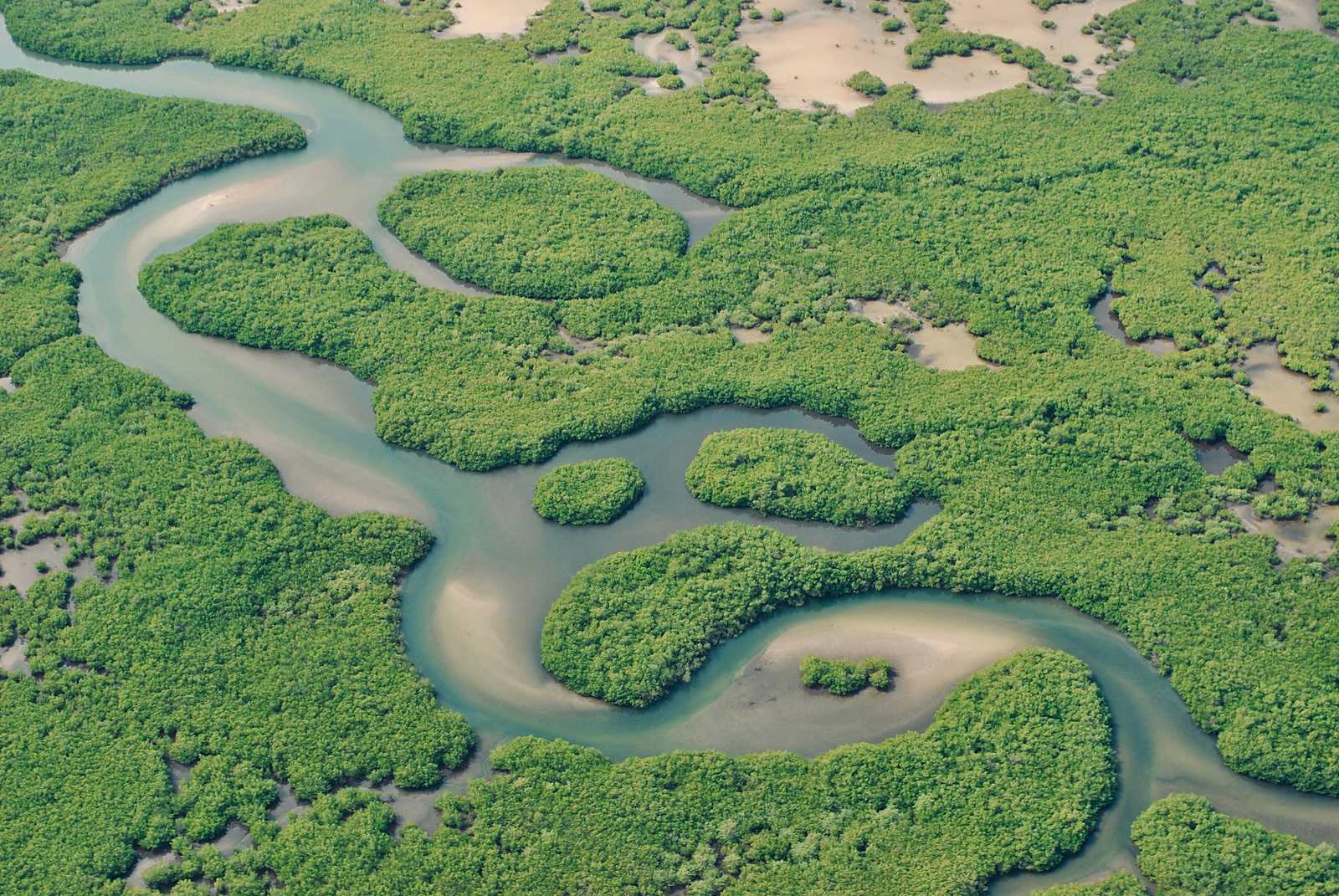
Between the two, there is water. A lot of water. If you plan to combine Ndangane and Toubacouta in the same trip, this is not a short local loop: it is two separate bases separated by a long overland detour. Choose, or allow the time.
Distances and durations: what we know, and what we don’t
| Destination | Distance from Dakar | Duration | Reliability |
|---|---|---|---|
| Kaolack | 184 to 190 km | — | Solid, 3 sources |
| Ndangane | 150 to 160 km | 2 h 30 to 3 h 30 | Range, sources diverge |
| Palmarin | not cross-checked | 3 h to 4 h | Duration reliable, mileage not |
| Toubacouta | 250 to 270 km | ~4 h | Range, to be confirmed |
We prefer to show ranges and "not cross-checked" rather than a neat table of clean figures. For Palmarin in particular, no source gives a mileage from Dakar that is confirmed elsewhere; the lodges quote durations, not distances. We will not fill the gap with an in-house estimate.
One point that matters since August 2026: all the durations you will find online were written before the motorway opened. They describe a route that is no longer the main route. No official time saving has been published to date, so we will not announce one to you — but expect better than what is written elsewhere.
The trap of the Thiadiaye exit
Here is the detail that is worth the price of this article if you are returning from Toubacouta towards Ndangane, or from the south to the north of the delta.
The new motorway has only three interchanges: Thiadiaye, Fatick and Kaolack. There is nothing between Thiadiaye and Fatick. As a result: coming from Kaolack and wanting to reach the Ndiosmone – Fimela road, you overshoot your turn-off, you exit at Thiadiaye, and you double back along the N1. The residents of Ndiosmone, Fimela, Palmarin and Djiffer, who are publicly calling for an additional exit near Médina Dokh, put this detour at around ten kilometres and call it utterly senseless.
It is not a disaster. But with children in the back and an arrival timed to the last minute before nightfall, it is better to have built it into your schedule than to discover it on the spot.
The toll, and the detail that directly concerns your vehicle
| Item | Amount (light vehicle) |
|---|---|
| Toll Dakar → Kaolack, total | 6,500 F CFA |
| Of which Mbour → Kaolack section alone | 3,000 F CFA |
| Dakar → Mbour | in the region of 3,500 F CFA |
| Foundiougne bridge — private car | 1,000 F CFA |
| Foundiougne bridge — 4x4 | 1,500 F CFA |
| Petrol super / diesel | 990 F CFA / 755 F CFA per litre |
The first two figures are solid: they come from a statement by the Société nationale Autoroutes du Sénégal published in August 2026 to deny a rumour of 15,000 F CFA for the round trip. The third is an order of magnitude obtained by subtraction, not a published tariff.
The two Foundiougne bridge lines are worth pausing on, because they are the only place in Senegal, to our knowledge, where the type of vehicle you rent directly changes what you pay: a 4x4 pays 50% more than a saloon on this crossing. This is not what should decide your choice, but it is one more argument in favour of the crossover over the big off-roader. Be careful, though: this scale dates from April 2022 and we have not found any more recent confirmation. Check at the toll.
Where the tarmac ends — the real question
All the travel writing about the Sine-Saloum describes dirt tracks. It is out of date.
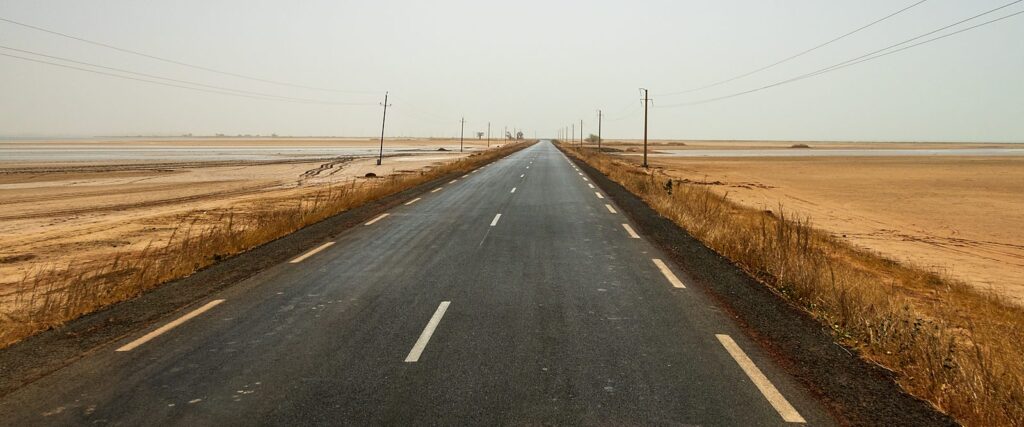
The Joal – Samba Dia – Palmarin – Djiffer axis has been surfaced and delivered. This is established by three independent sources, even if they disagree on the exact length of the works — 40, 42 or 49 kilometres depending on the version. Palmarin is therefore served by a tarmac road. If you read an account that tells you there is a dirt track on this section, it predates the works.
For Ndangane and Fimela, the sources agree on a surfaced-road link right up to the villages, but we have only two confirmations and not three. We flag it as probable, not as certain. Sokone and Toubacouta are on national road 5: it is a surfaced national road, but no source consulted documents its current surface condition, so we will say nothing about its quality.
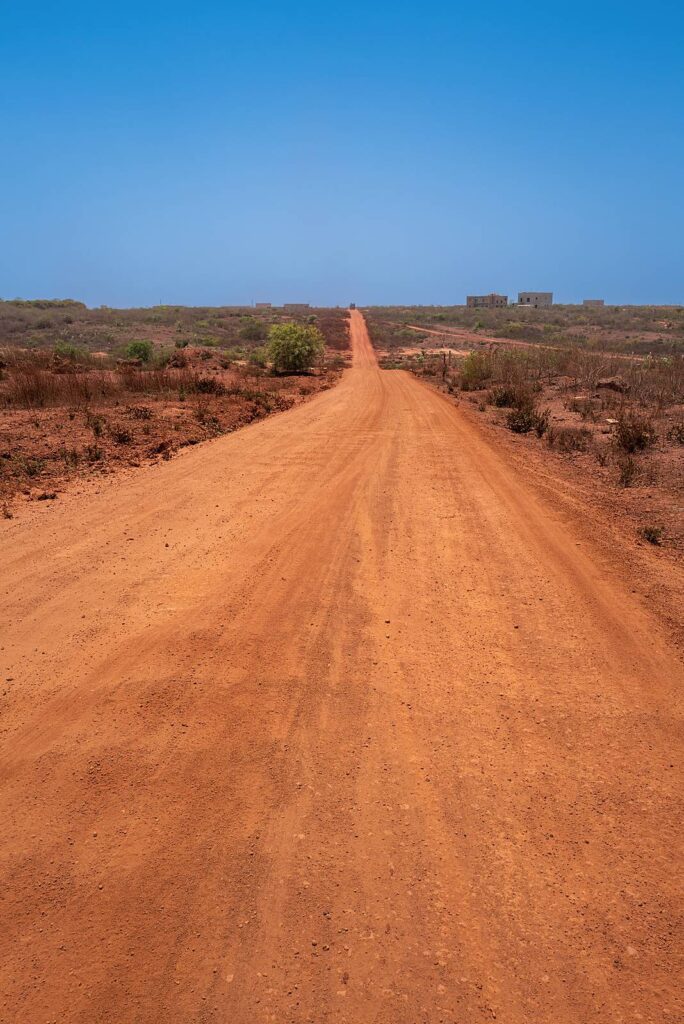
The dirt track still exists — but it has moved. It is now on the final stretch, the one from the village to the lodge. At Palmarin, the establishments themselves describe their access as "tarmac road then dirt track", with directions such as "take the track on the left at the entrance to Palmarin Ngallou". None of them quotes the length of this track. That is where, and only where, your ground clearance comes into play.
Mar Lodj: the car stops before
If your trip includes Mar Lodj, be aware that you will not be taking the car there. It is an island in the delta, facing Ndangane, and you reach it by pirogue — between fifteen and thirty minutes depending on the boat and on the sources, which do not agree. On the island, there are no motorised vehicles: you get around on foot or by cart.
Two pieces of information we do not have, and that we will not replace with guesswork: the pirogue fare, which no public source gives, and the existence of a guarded public car park at Ndangane. What we do know is that some Mar Lodj lodges advertise a private guarded car park at their jetty for the duration of the stay. The cautious wording is therefore this one: parking at Ndangane is arranged with your accommodation, ask for it when you book. Do not set off assuming there will be a solution on site.
Travelling with children: what really matters
The delta is a remarkable family destination, provided you accept that it is experienced slowly. A few concrete points.
How you split up the day. With the motorway, the genuinely fast-flowing portion is now continuous as far as Fatick or Kaolack. Take one real break, taken properly, rather than four forced stops.
The boot. This is the number-one argument for the SUV or crossover on this destination, ahead even of ground clearance. Pushchair, car seats, cool box, games, luggage for four or five: a compact car is not enough, and driving with a boot filled to the brim degrades roadholding on a sandy track.
Filling up. No public source documents the location of the delta’s petrol stations. The silence of the sources is itself information here: fill up at Mbour, Joal or Kaolack, before leaving the main roads. This is not a sourced fact, it is a principle of caution — we prefer to present it to you as such.
The network. We have found no reliable data on mobile coverage in the delta and on the islands. We will therefore not claim there are dead zones, but download your offline maps before setting off. It costs nothing and settles the question.
Resident or visitor
For a family based in Dakar
the Sine-Saloum has just come closer, and that is the real lesson of the year. A departure late on Friday becomes realistic for the northern gateway. Think about the resident rate: with the hire companies that offer one, it appears automatically once your resident account has been verified.
For a family passing through
the question to settle is the number of bases. Two nights in the same place are worth more than two nights in two different villages separated by the delta. The time you think you gain by changing location, you spend in the car.
When to go
The dry season, from November to May, is the right window: between 26 and 32°C during the day, migratory birds, comfortable pirogue trips.
The rainy season — the sources waver between July-September and June-October — degrades the secondary roads and the tracks, and it is precisely at this time that a vehicle with raised ground clearance stops being a comfort. In the Fatick region, the seasonal isolation of certain villages is documented: detours of several kilometres over flooded sandy tracks. This concerns village links more than the main tourist itinerary, but it says something about the state of the secondary network in this season.
On the opening of the lodges in August-September, the sources frankly contradict one another: some announce closures, others devote entire articles to delta establishments that stay open with promotions. The honest conclusion: it depends on the establishment, check case by case.
So, which car?
An SUV or a crossover, and here is the case stripped of everything that is not true.
The Dakar → delta journey is today motorway followed by surfaced roads. It justifies no particular vehicle. No verifiable source presents a true 4x4 as indispensable for reaching the delta in the dry season, and we will not go beyond what the sources say.
What justifies the SUV is three things: boot volume for a family, ground clearance on the last kilometres up to the lodge, and the rainy season if you come at that time. It is a choice of comfort and margin, not an expedition choice. The only detailed on-the-ground account we have found about the delta’s secondary tracks — a heavy vehicle, in April, so at the height of the dry season — reports repeated boggings-down in the salt crusts and this lesson that deserves quoting: even when degraded, it is better to stay on the main track, the secondary tracks being sandier and more treacherous.
Finally, remember the Foundiougne bridge. If your itinerary passes through there, the crossover costs you 1,000 F CFA and the big 4x4 1,500 F CFA. It is not a decisive argument. It is one more sign that on this destination, the off-roader is not the right tool.
Frequently asked questions
Do you need a 4x4 to go to the Sine-Saloum?
No, not to get there. Since the opening of the Mbour – Fatick – Kaolack motorway in August 2026, access to the delta is by motorway then by surfaced roads, including as far as Palmarin, whose access axis has been surfaced. An SUV or a crossover is justified for the boot, for the last kilometres of track up to the lodges, and in the rainy season. No source presents a true 4x4 as indispensable in the dry season.
How much is the toll from Dakar to the Sine-Saloum?
6,500 F CFA for a light vehicle from Dakar to Kaolack, of which 3,000 F CFA for the Mbour – Kaolack section alone. These amounts are those communicated officially by the Société nationale Autoroutes du Sénégal in August 2026. If your itinerary uses the Foundiougne bridge, allow 1,000 F CFA more for a car, 1,500 F CFA for a 4x4.
Can you go to Mar Lodj by car?
No. Mar Lodj is an island: you leave the vehicle at Ndangane and cross by pirogue, between fifteen and thirty minutes. There are no motorised vehicles on the island; you get around on foot or by cart. Parking at Ndangane is arranged with your accommodation — ask for it when you book, do not count on a public car park.
How long is the drive from Dakar?
From 2 h 30 to 3 h 30 for Ndangane, 3 to 4 hours for Palmarin, about 4 hours for Toubacouta. These durations come from sources predating the opening of the motorway in August 2026: as no official time saving has been published, we leave them as they are, but they are probably pessimistic today.
Can you combine Ndangane and Toubacouta in the same trip?
Yes, but they are not neighbouring destinations. Ndangane belongs to the northern gateway of the delta, via Mbour and the N1; Toubacouta to the southern gateway, via Kaolack and the N5. Between the two there is the delta, and so an overland detour. Allow a real half-day of transfer and not a short hop.
What does the rainy season change?
It degrades the secondary roads and the tracks, and it is the period when ground clearance becomes genuinely useful. The seasonal isolation of villages in the Fatick region is documented. On the opening of the lodges in August-September, the sources contradict one another: check establishment by establishment.